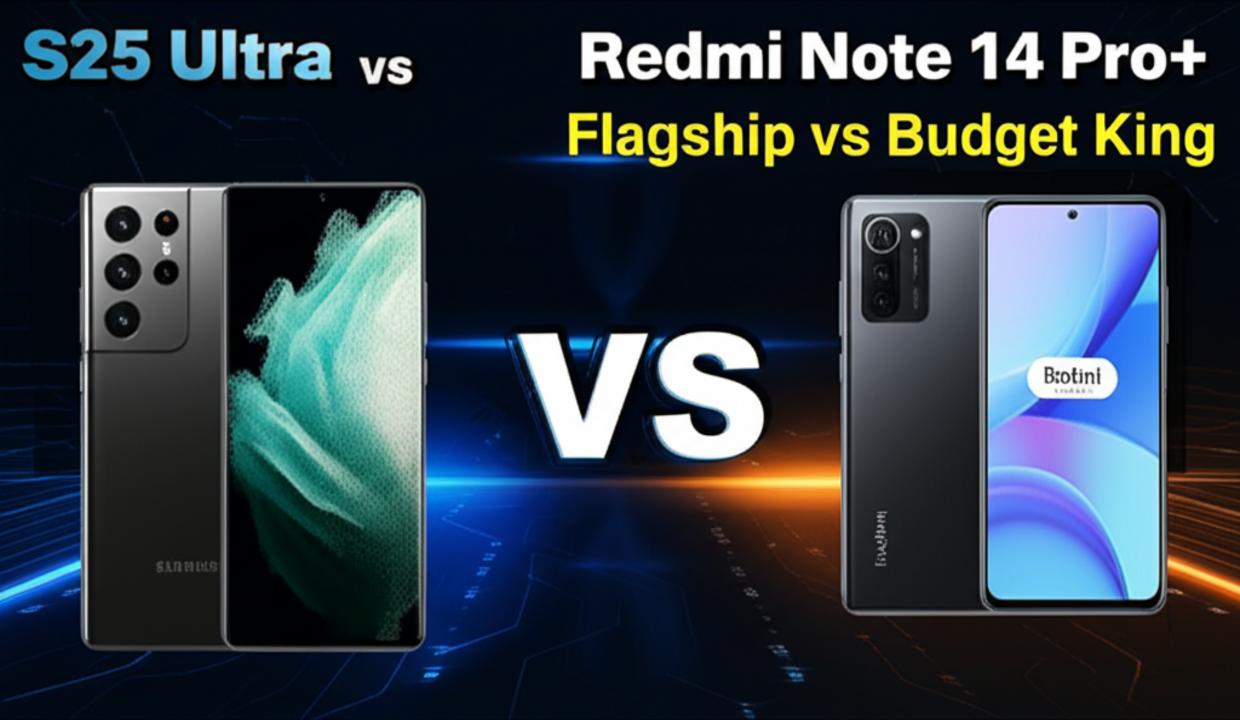
Welcome to the ultimate 5G phone comparison where we pit two titans, albeit from very different weight classes, against each other: the much-anticipated Samsung Galaxy S25 Ultra and the budget-friendly contender, the Redmi Note 14 Pro+. In today’s fast-paced world, choosing the right smartphone is more than just picking a device; it’s about investing in a companion that fits your lifestyle, budget, and performance needs. With 5G becoming standard, both phones promise next-gen connectivity, but their approaches to delivering a premium experience couldn’t be more different. This deep dive will help you decide which device truly reigns supreme for your specific requirements.
Are you a power user seeking the absolute pinnacle of mobile technology, or do you prefer a cost-effective solution that still packs a punch for everyday tasks? The S25 Ultra vs Redmi showdown is designed to answer these questions, examining everything from raw processing power to camera capabilities, display brilliance, and battery endurance. Let’s find out which phone truly offers the best 5G phone experience for you.
Main Highlights: Samsung Galaxy S25 Ultra vs Redmi Note 14 Pro+
Understanding the core differences between these two devices is crucial before diving into the specifics. Here’s a quick overview of what sets them apart:
- Processor: The Samsung Galaxy S25 Ultra boasts the bleeding-edge Snapdragon 8 Elite (4.47GHz Octa-core), offering unparalleled power and efficiency. The Redmi Note 14 Pro+, on the other hand, comes with an Octa-core 2.5 GHz chip, designed for reliable mid-range performance.
- RAM & Storage: Expect 12GB or 16GB RAM for the S25 Ultra, paired with storage up to 1TB. The Redmi Note 14 Pro+ typically offers 8GB or 12GB RAM and up to 256GB storage.
- Display: The S25 Ultra shines with a 6.9-inch Dynamic AMOLED 2X QHD+ (3200×1440) display, featuring a 120Hz adaptive refresh rate. The Redmi Note 14 Pro+ has a 6.67-inch AMOLED, likely FHD+ with 120Hz, but less bright and sharp.
- Camera: A professional-grade quad-camera system on the S25 Ultra includes a 200MP main sensor, dual telephoto lenses (50MP 5x periscope, 10MP 3x), and a 50MP ultra-wide. The Redmi Note 14 Pro+ offers a capable high-resolution main camera (often 50MP+) but lacks the advanced telephoto or video features.
- Battery & Charging: Both feature approximately 5000mAh batteries. The S25 Ultra supports faster 45W wired and 25W wireless charging, while the Redmi Note 14 Pro+ uses 33W wired charging, often without wireless support.
- Price: This is where the biggest divergence lies. The Samsung Galaxy S25 Ultra is a premium flagship at around ₹1,17,999, whereas the Redmi Note 14 Pro+ is a budget-midrange option at roughly ₹25,700.
Performance and Key Features
When it comes to raw horsepower, the Samsung Galaxy S25 Ultra stands in a league of its own. It’s powered by the cutting-edge Snapdragon 8 Elite chipset, a marvel of mobile engineering. This processor doesn’t just promise speed; it delivers substantial efficiency gains, with CPU performance reportedly 44% better and GPU performance 40% more efficient than its predecessor. For users who engage in heavy gaming, intensive video editing, or demanding multitasking, the S25 Ultra offers a buttery-smooth, lag-free experience that truly defines a flagship. Its advanced AI features, deeply integrated into One UI 6, further optimize performance and power management, learning from your usage patterns to enhance responsiveness and battery life.
On the other side of the spectrum, the Redmi Note 14 Pro+ aims for balance and affordability. Its Octa-core 2.5 GHz processor, likely a capable mid-range Snapdragon or MediaTek chip, is perfectly adequate for daily tasks. Browsing social media, streaming videos, casual gaming, and messaging apps will run without a hitch. However, pushing it with graphics-intensive games or multiple heavy applications simultaneously will reveal its limitations compared to the S25 Ultra. The difference in RAM, with the Redmi Note 14 Pro+ typically offering 8GB or 12GB compared to the S25 Ultra‘s 12GB or 16GB, also impacts its multitasking prowess. While the Redmi provides excellent value for its price, it’s crucial to align your performance expectations with its mid-range positioning. For more insights into what the S25 Ultra brings to the table, you can read up on the latest Samsung Galaxy S25 Ultra rumors.
Display Deep Dive: Visual Brilliance
The visual experience on a smartphone is paramount, and here, the Samsung Galaxy S25 Ultra truly shines. Its magnificent 6.9-inch Dynamic AMOLED 2X QHD+ display, boasting a resolution of 3200×1440 pixels, delivers breathtaking clarity, vibrant colors, and deep blacks. The adaptive 120Hz refresh rate ensures incredibly smooth scrolling, fluid animations, and a highly responsive touch experience, whether you’re gaming or simply navigating the UI. This display is designed for consumers who demand the very best for media consumption, content creation, and an immersive viewing experience.
The Redmi Note 14 Pro+ offers a commendable display for its price segment. Featuring an approximately 6.67-inch AMOLED panel with a likely 120Hz refresh rate, it provides good contrast and decent brightness for everyday use. However, its resolution is typically FHD+, which means it won’t be as razor-sharp as the S25 Ultra‘s QHD+ panel. While perfectly enjoyable for most users, side-by-side, the Redmi Note 14 Pro+‘s display will appear less vibrant, less bright, and less detailed, especially in challenging lighting conditions or when viewing high-resolution content. It’s a testament to the fact that premium displays come at a premium cost.
Camera Capabilities: Capture Every Moment
For photography enthusiasts, the Samsung Galaxy S25 Ultra is nothing short of a portable professional camera studio. Its quad-camera setup is headlined by an astonishing 200MP main sensor, capable of capturing incredible detail and stunning low-light performance. Complementing this are dual telephoto lenses: a 50MP 5x periscope telephoto and a 10MP 3x telephoto, offering unparalleled zoom versatility without significant loss in quality. An upgraded 50MP ultra-wide lens ensures expansive landscape shots and excellent group photos. Video recording capabilities are equally impressive, supporting 4K at 120fps and even 8K video recording, perfect for aspiring videographers and content creators. The computational photography and AI enhancements further refine images, ensuring every shot is picture-perfect.
The Redmi Note 14 Pro+, while not on the same level as the S25 Ultra, still offers a very capable camera system for its price point. It typically features a high-resolution main camera, often 50MP or more, which performs well in good lighting conditions. For social media posts, casual photos, and everyday snapshots, it delivers pleasing results. However, where it falls short compared to the S25 Ultra is in its versatility and advanced features. It usually lacks the sophisticated telephoto lenses, often relying on digital zoom. Its ultra-wide sensor will likely be of lower resolution, and video capabilities will be more limited, usually capping at 1080p or 4K at 30fps. For a deeper dive into the S25 Ultra‘s advanced features, you can check out this article on Samsung Galaxy S25 Ultra rumoured specifications.
Battery & Charging: Powering Your Day
Battery life is a critical factor for any smartphone user, and both the Samsung Galaxy S25 Ultra and the Redmi Note 14 Pro+ come equipped with substantial 5000mAh batteries. This capacity generally translates to excellent all-day usage for most users, even with moderate to heavy usage. However, the difference lies in how quickly these devices can replenish their power.
The S25 Ultra supports 45W wired charging, allowing it to go from empty to full in a relatively short amount of time. Crucially, it also features 25W wireless charging, adding a layer of convenience for users with compatible charging pads. This allows for quick top-ups throughout the day without fumbling with cables. The Redmi Note 14 Pro+, while offering a similar battery capacity, typically comes with slower wired charging, usually around 33W. While still decent, it won’t charge as rapidly as the S25 Ultra. Furthermore, wireless charging support is often absent in this segment, making wired charging the only option for many users. This is a key convenience factor that flagship devices like the S25 Ultra offer.
Software & User Experience
The software experience can profoundly impact daily usability. The Samsung Galaxy S25 Ultra ships with Android 15, overlaid with Samsung’s highly refined One UI 6. This combination offers a clean, intuitive, and feature-rich interface. Samsung is known for its excellent software support, providing years of OS updates and security patches. One UI 6 on the S25 Ultra is expected to be deeply integrated with advanced AI features, offering smarter performance management, enhanced photo editing capabilities, and potentially revolutionary new ways to interact with your device. This premium software experience contributes significantly to the overall flagship feel.
The Redmi Note 14 Pro+ runs on Android 14, customized with Xiaomi’s proprietary MIUI skin. MIUI is known for its extensive customization options, unique visual flair, and a plethora of features, sometimes even more than stock Android. However, some users might find it a bit cluttered or experience occasional bloatware. While Xiaomi has improved its software update policy, it may not match Samsung’s long-term commitment for flagship devices. The overall experience is solid for its price point, offering good functionality, but it lacks the cutting-edge AI integrations and the polished, optimized feel of Samsung’s flagship software. For a direct comparison of tech specs, you can also check out this versus comparison.
Pricing and Market Position
The price difference between the Samsung Galaxy S25 Ultra and the Redmi Note 14 Pro+ is arguably the most significant differentiator. The Samsung Galaxy S25 Ultra is positioned as a top-tier flagship smartphone, with a price tag reflecting its cutting-edge technology, premium build materials, extensive features, and brand prestige. In India, it’s expected to retail around ₹1,17,999, and globally, prices could start around $1,299. This makes it an investment, catering to users who demand the very best and are willing to pay for it.
In stark contrast, the Redmi Note 14 Pro+ is a quintessential budget-midrange phone. Its approximate price of ₹25,700 in India makes it accessible to a much wider audience, offering exceptional value for money. While it can’t compete with the S25 Ultra on raw specifications, it delivers a robust smartphone experience for its price, making it an excellent choice for everyday users, students, or anyone looking for a capable device without breaking the bank. This huge price gap means they target entirely different market segments, fulfilling different consumer needs. For a detailed price and spec comparison, you can look at this Smartprix comparison.
Pros and Cons
| Samsung Galaxy S25 Ultra Pros | Samsung Galaxy S25 Ultra Cons |
|---|---|
| Unmatched Snapdragon 8 Elite performance. | Very high price point. |
| Stunning 6.9-inch QHD+ Dynamic AMOLED 2X display. | Potentially overkill for average users. |
| Industry-leading 200MP quad-camera system with advanced zoom. | Large size might not suit all hands. |
| Fast 45W wired and 25W wireless charging. | Charger often sold separately. |
| Premium build quality and materials. | AI features might require subscriptions in the future. |
| Long-term software support and AI features. |
| Redmi Note 14 Pro+ Pros | Redmi Note 14 Pro+ Cons |
|---|---|
| Extremely affordable price. | Mid-range processor not for heavy tasks. |
| Good battery life with 5000mAh capacity. | Camera system less versatile than flagships. |
| Decent AMOLED display with 120Hz refresh rate. | No wireless charging. |
| Solid performance for everyday use. | MIUI can have pre-installed bloatware. |
| Value for money proposition. | Build materials are typically plastic. |
FAQ
- Is the Samsung Galaxy S25 Ultra worth the significant price difference over the Redmi Note 14 Pro+?
The Samsung S25 Ultra is absolutely worth it if you demand the best in every aspect: cutting-edge performance for heavy gaming or professional use, a top-tier camera, unparalleled display quality, and premium build. If these are non-negotiable for you and your budget allows, then yes, the investment is justified for a truly flagship experience. - How does 5G performance differ between the two phones?
While both are 5G phones, the Samsung Galaxy S25 Ultra, with its more advanced modem integrated into the Snapdragon 8 Elite, will likely offer superior 5G speeds, better signal stability, and support for a wider range of 5G bands, including mmWave in some regions. The Redmi Note 14 Pro+ will provide reliable sub-6GHz 5G, perfectly adequate for most users, but potentially less optimized for peak performance or future-proofing. - Which phone is better for mobile gaming?
Without a doubt, the Samsung Galaxy S25 Ultra is the superior choice for mobile gaming. Its powerful Snapdragon 8 Elite processor and advanced GPU deliver significantly higher frame rates, better graphics rendering, and a smoother overall gaming experience. The QHD+ 120Hz display further enhances immersion, making it the ideal device for serious mobile gamers. - Does the Redmi Note 14 Pro+ offer good value for money?
Yes, the Redmi Note 14 Pro+ offers excellent value for money. For its price point of around ₹25,700, it provides a well-rounded package including a large AMOLED 120Hz display, a capable main camera, and a sizable battery. It’s a fantastic option for users who need a reliable smartphone for daily tasks without stretching their budget to flagship levels. - What about software updates and long-term usability for each device?
Samsung generally offers longer and more consistent software support for its flagship devices like the Galaxy S25 Ultra, typically providing several years of major Android OS updates and security patches. Xiaomi’s support for the Redmi series is good but might not match the longevity of a Samsung flagship. Both phones should remain usable for several years, but the S25 Ultra has an edge in long-term feature and security updates.
Conclusion
The Samsung Galaxy S25 Ultra vs Redmi Note 14 Pro+ showdown is less of a direct competition and more of a clear illustration of market segmentation. The Samsung Galaxy S25 Ultra stands as the pinnacle of mobile technology, a true flagship designed for users who demand uncompromising performance, professional-grade photography, a stunning display, and all the premium features money can buy. It’s an investment in the best possible smartphone experience, reflecting its price tag of around ₹1,17,999.
Conversely, the Redmi Note 14 Pro+ carves out its niche as an outstanding budget-midrange smartphone. Priced at approximately ₹25,700, it offers incredible value, delivering a solid all-around experience for everyday tasks, media consumption, and casual photography. While it can’t match the raw power or advanced features of the S25 Ultra, it never pretends to. Instead, it focuses on providing reliable performance and a pleasant user experience without breaking the bank.
Ultimately, your choice depends entirely on your needs and budget. If you’re a power user, a mobile photographer, or simply someone who wants the absolute best Android phone experience with no compromises, the Samsung Galaxy S25 Ultra is your undisputed champion. However, if you’re seeking a highly capable, reliable, and affordable 5G phone for daily use, the Redmi Note 14 Pro+ is an excellent choice that delivers fantastic value. Both phones are great in their respective categories, proving that the best 5G phone isn’t just one device, but the one that best suits *your* lifestyle. #5GShowdown
Feel free to share your thoughts in the comments below or explore more insightful comparisons on our About Us page. For any questions, don’t hesitate to Contact us.
Watch More in This Video
Disclaimer: All images and videos are sourced from public platforms like Google and YouTube. If any content belongs to you and you want credit or removal, please inform us via our contact page.